What a fence actually costs
Fences are priced by the foot. Nearly every contractor quotes that way, and this calculator works the same way: a materials price per foot, a labor price per foot, and gates on top.
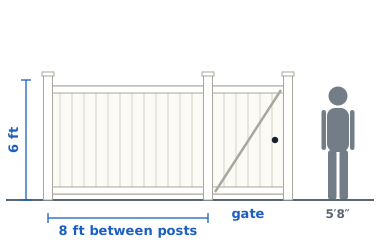
Take a plain 150-foot wood privacy fence, 6 feet tall, with one walk gate. Materials at $18 a foot come to $2,700. Labor at $17 a foot adds $2,550. The gate is $350. That's $5,600, and because no two yards are alike, we'd call it $4,760 to $6,440.
Here's the same 150 feet in other materials, at the prices we last checked in October 2026:
| Fence | Materials / ft | Labor / ft | Installed / ft | 150 ft installed |
|---|---|---|---|---|
| Wood privacy, pine, 6 ft | $18 | $17 | $30–$40 | $4,460–$6,040 |
| Wood privacy, cedar, 6 ft | $24 | $17 | $35–$47 | $5,230–$7,070 |
| Vinyl privacy, 6 ft | $28 | $12 | $34–$46 | $5,100–$6,900 |
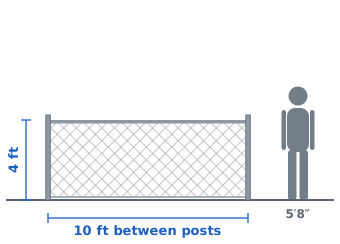
| Chain link, galvanized, 4 ft | $7 | $8 | $13–$17 | $1,910–$2,590 |
| Chain link, vinyl-coated, 4 ft | $10 | $8 | $15–$21 | $2,300–$3,100 |
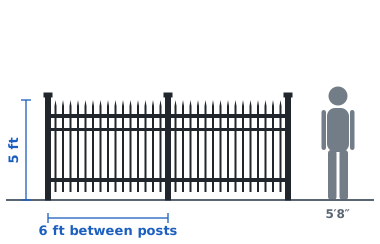
| Aluminum, flat top, 4 ft | $26 | $12 | $32–$44 | $4,850–$6,550 |
Two things the table can't show you. Gates, which are priced one at a time. And your yard, which we can't see from here.
Measuring without overthinking it
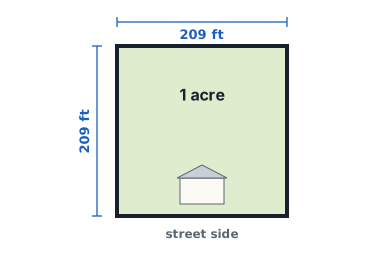
You only need one number: the length of the fence line in feet. Push a stake in at each corner and each end, measure from stake to stake along the ground, and add it up. A 100-foot tape does the job. A measuring wheel is quicker on a long run.
While you're out there, decide where the gates go. A 4-foot gate is plenty for people, wheelbarrows and a push mower. A wide riding mower or a trailer needs a drive gate. Picking the spot now costs nothing. Adding a gate to a finished fence costs a lot.
No long tape? Your property survey lists the lot's dimensions, and most counties have a free parcel map online. Either one is close enough for a first estimate.
Where quotes go sideways
If a contractor's number comes in well above the range up top, it's usually for one of these reasons.
Height is the big one. Going from 6 feet to 8 isn't just a third more fence. It means longer posts, deeper holes and heavier panels, and plenty of cities want a permit once you go that tall.
The ground is the one nobody can price over the phone. Rock, roots and clay slow a crew down. On a slope, every panel has to be stepped or cut to follow the grade.
Gates cost more than they look like they should. A drive gate needs heavier posts, real hinges and a frame that won't sag, and the bill for one can match a long stretch of fence.
Then there's whatever is standing there now. Somebody has to tear it out and haul it off, and it's a bigger line than most people expect. We split it out in the fence removal calculator.
Last, where you live. Labor swings more between regions than anything else on the bill, which is what the labor setting is for.
Doing it yourself
Switch the calculator to "I will" and the labor line drops to zero. On the example above that's $2,550 you keep, which is why so many people think about it.
Here's what you're signing up for: a post hole every 8 feet, a lot of concrete, and a long line of posts that all have to end up straight and plumb. One hole is easy. Twenty of them is a long weekend, so rent a power auger. Set the corner posts first, pull a string between them, and set everything else to the string.
For depth, plan on at least 2 feet in the ground for a 6-foot fence, and more where the ground freezes hard. That's why a 6-foot fence is built with 8-foot posts.
Buying the lumber yourself? The picket calculator turns the length into a shopping list, and the post hole calculator works out the concrete.
Before anybody digs
Call 811. It's the free national line for getting buried gas, power and cable marked, and you're supposed to call a few business days ahead. Finding a gas line with an auger is a bad day.
Know where your property line really is. The old fence, the hedge and the mowing line are all guesses. A survey isn't cheap, but it costs less than moving a fence.
And read the rules. Cities and HOAs set height limits, sometimes materials and colors, and often which way the fence faces. The usual convention is that the finished side faces out, toward the neighbors and the street.
Fair questions
How close is this to a real quote?
Close enough to tell a fair quote from a silly one. The suggested prices are national mid-range figures, so a quote inside the range is normal and one far outside it deserves a question. Get three quotes either way.
Why let me change the prices?
Because your numbers beat ours. If the store down the road sells panels for less, or a contractor already gave you a per-foot price, open "Use my own prices" and type it in.
Is sales tax or the permit in here?
No. Both depend on where you live. Your city's building department can tell you the permit fee in one phone call.
Sources
- Call 811: the national call-before-you-dig service, for when and how to have buried utilities marked.
- Quikrete, Setting Posts in Concrete: hole width, hole depth and how much concrete a post takes.
- How we calculate: every suggested price behind this calculator, with the date it was last reviewed.